




Fixed income relative value strategies designed to diversify and strengthen portfolios.
We capture the spread that highly rated covered bonds pay over government bonds and swaps, across Europe with Scandinavia at the core, hedged and scaled with leverage.
Key facts
- 2016 Founded in CopenhagenOur story
- ~€270m Assets under managementOur funds
- Independent 100% owned by principalsCorporate governance
- Fixed Income Relative ValueOur strategy
News & awards
Latest news
- Press HedgeNordic Roundtable Operational Challenges in Asset Management HedgeNordic · November 2026
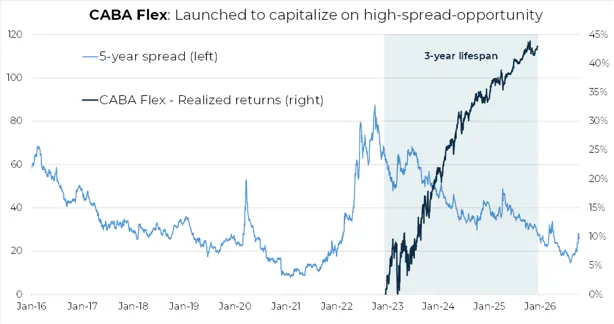
- Press CABA Flex: Buying the Spread When It Pays Read the case study here: CABA Flex: Buying the Spread When it Pays October 2026
- Press How CABA Capital Is Navigating the New Operational Demands For Mette Østerbye Vejen, Chief Executive Officer of Danish fixed-income boutique CABA Capital, the evolution is particularly visible in the growing demands around regulation, governance and investor reporting. HedgeNordic · September 2026
Awards
-
 #1 Best Performing Fixed Income Hedge Fund
BarclayHedge 2025 · CABA Hedge
December 2025
-
Top 10 Performing Hedge Funds - Past Three Years
BarclayHedge 2025 · CABA Hedge
December 2025
-
 Best Nordic Fixed-Income Hedge Fund: third place
2024 Nordic Hedge Award · CABA Hedge
April 2025
-
 Emerging Performance of the Year: Credit Relative Value
Hedgeweek European Awards · CABA Flex
April 2025
-
Credit Newcomer of the Year: 12 Months
Hedgeweek European Emerging Manager Awards · CABA Flex
November 2024
-
 Newcomer: Credit
HFM European Performance Awards · CABA Hedge
July 2020